
- Home page
- buying guide
- surveillance aircraft
surveillance aircraft
surveillance aircraft: A technical guide

4 Criteria to choose your surveillance aircraft
Sensor Payload Capacity
Effective ISR platforms must accommodate heavy electro-optical balls and radar systems while maintaining center of gravity and power margins.
Operational Loiter Endurance
Extended time on station is vital for persistent monitoring of targets without frequent refueling interruptions or base rotations.
Data Link Throughput
High bandwidth communication systems are required to transmit real-time high-definition video and signals intelligence to ground control centers.
Airworthiness Certification Level
Compliance with EASA or FAA standards ensures the aircraft can operate safely within shared civilian and military airspaces.
Available technologies and advantages
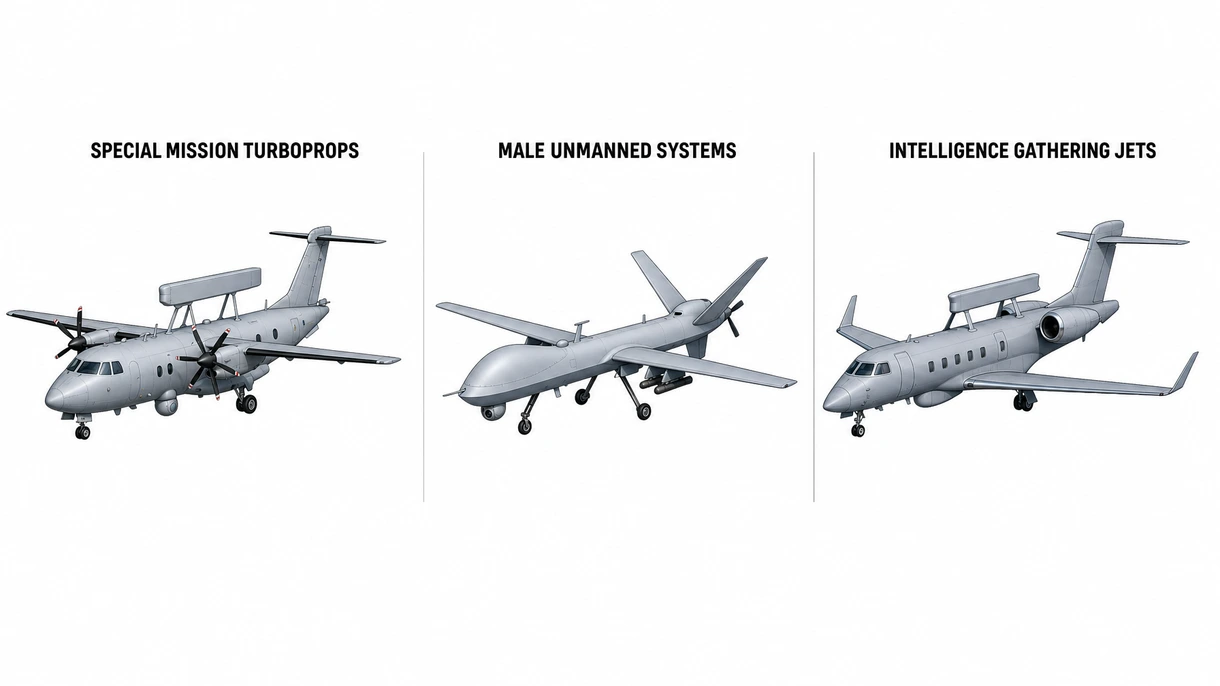
Special Mission Turboprops
These aircraft utilize fuel-efficient engines for long-range patrol missions, offering a balanced mix of speed and lift capability for rugged environments. They provide lower operating costs and short takeoff performance, but suffer from lower cruising altitudes and limited speed compared to modern jet-powered intelligence platforms.
MALE Unmanned Systems
Medium-altitude long-endurance drones provide superior persistence without crew fatigue, utilizing satellite links for remote operation across global distances during complex missions. They offer unmatched endurance and safety for high-risk zones, yet encounter significant challenges regarding integration into non-segregated civilian airspaces and high initial infrastructure costs.
Intelligence Gathering Jets
Modified business jets provide high-altitude transit speeds and pressurized environments for complex signal intelligence suites and specialized operator consoles. These platforms reach targets quickly and operate well above commercial traffic, but suffer from high fuel consumption and demanding maintenance requirements for their high-performance engines.
6 expert tips
Prioritize modular open systems to allow for rapid sensor hardware upgrades without needing costly and time-consuming airframe recertification.
Select platforms with high electrical output to support concurrent operation of multiple high-draw electronic intelligence and radar suites.
Evaluate the total cost of ownership by including long-term maintenance cycles and specialized technician training for proprietary systems.
Ensure airframes possess sufficient cooling capacity to prevent mission computer overheating during prolonged operations in high-temperature desert environments.
Assess the compatibility of onboard data encryption protocols with existing defense communication networks to ensure secure information sharing.
Verify that the aircraft landing gear is rated for austere airfield operations to maximize deployment flexibility in remote areas.
Always verify the technical certification to ensure compliance with local building safety standards and long-term durability.
Innovations and Trends
. Onboard artificial intelligence filters massive sensor datasets to provide operators with immediate, actionable intelligence while reducing bandwidth needs.
. Multiple small cameras around the fuselage provide spherical situational awareness, significantly improving threat detection and collision avoidance capabilities.
. Implementation of hydrogen propulsion reduces acoustic signatures for covert operations while providing zero-emission endurance for environmental monitoring missions.
. Low-earth orbit constellations enable low-latency, high-speed data transfer for unmanned platforms operating in areas without terrestrial infrastructure.
*Prices are pre-tax. They exclude delivery charges and customs duties and do not include additional charges for installation or activation options. Prices are indicative only and may vary by country, with changes to the cost of raw materials and exchange rates.
About AeroExpo
AeroExpo is a marketplace that offers B2B players a complete experience, from product sourcing to purchase. AeroExpo is an entity of VirtualExpo Group.
Are you a buyer?
Are you a supplier?