
- Home page
- buying guide
- paramotor wing
paramotor wing
paramotor wing: A technical guide
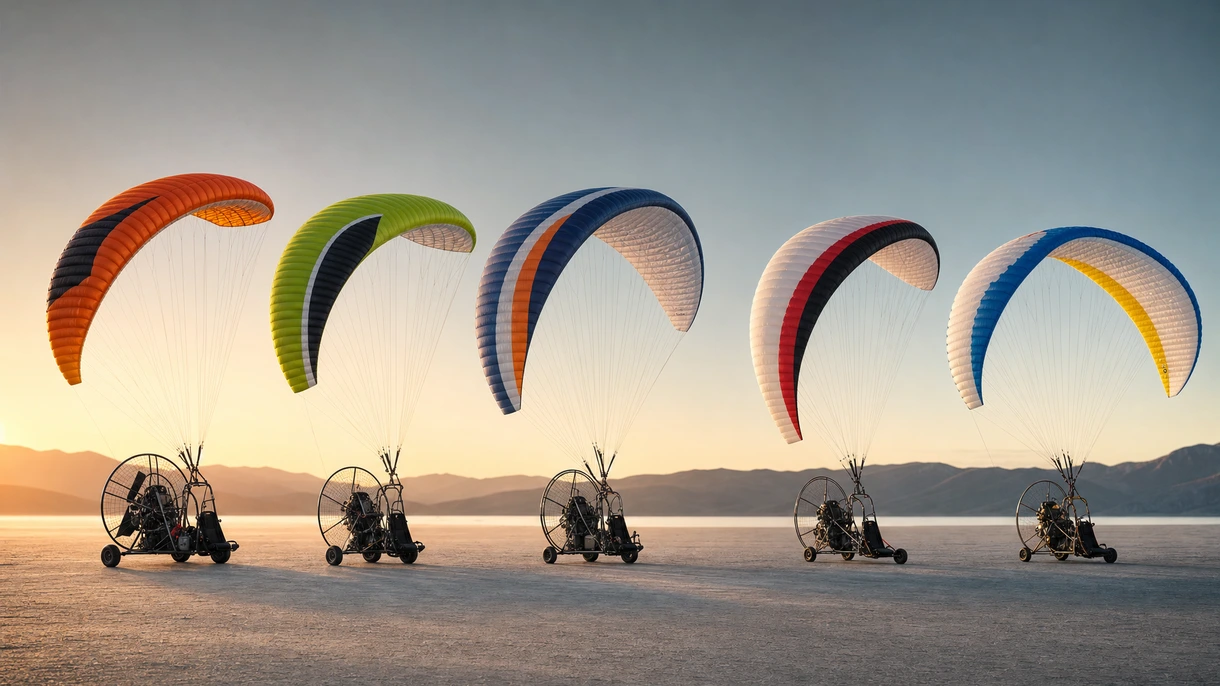
4 Criteria to choose your paramotor wing
Certified Airworthiness Standards
Ensuring compliance with European EN and French DGAC standards guarantees structural integrity and predictable flight behavior under various loads.
High Internal Pressure Stability
Shark-nose profiles and rigid foils maintain airfoil shape at high speeds, preventing collapses in turbulent, high-velocity operating environments.
Optimized Lift-to-Drag Ratio
This maximizes fuel efficiency and range for long-distance reconnaissance or surveillance missions by reducing aerodynamic drag and wing turbulence.
UV Degradation Resistance
High-tenacity Ripstop fabrics with siliconized coatings ensure long-term structural durability and color fastness in extreme atmospheric conditions.
Available technologies and advantages
Full Reflex Airfoils
This design uses S-shaped profiles to shift pressure centers forward, providing superior pitch stability at high speeds compared to traditional profiles. Advantages include high speed and collapse resistance, while limitations involve higher fuel consumption and demanding launch characteristics.
Hybrid Specialized Designs
These wings combine standard paragliding efficiency with partial reflex technology to balance fuel economy and stability across a wide speed range. Advantages include versatility and easy launch characteristics, though they offer lower top speeds and moderate agility compared to full-reflex models.
6 expert tips
Prioritize wings with full EN and DGAC certifications to guarantee maximum operational safety and compliance with international standards. Always verify the technical certification to ensure compliance with local building safety standards and long-term durability.
Select high-tenacity Porcher Sport or Dominico fabrics to ensure material longevity and consistent aerodynamic performance under high UV exposure. Always verify the technical certification to ensure compliance with local building safety standards and long-term durability.
Evaluate the wing loading specifications to match the total takeoff weight for optimal stability and efficient fuel consumption rates. Always verify the technical certification to ensure compliance with local building safety standards and long-term durability.
Implement rigorous inspection schedules focused on line length shrinkage and fabric porosity to maintain airworthiness and pilot safety levels. Always verify the technical certification to ensure compliance with local building safety standards and long-term durability.
Invest in 3D-shaping wing construction to reduce drag and improve the glide ratio during extended cross-country or monitoring missions. Always verify the technical certification to ensure compliance with local building safety standards and long-term durability.
Assess the riser system complexity to ensure compatibility with specific harness geometry and emergency parachute deployment mechanical systems. Always verify the technical certification to ensure compliance with local building safety standards and long-term durability.
Innovations and Trends
Inclusion of shape-memory alloys reduces overall weight while maintaining rigid profile shapes for improved portability and rapid deployment.
Implementation of high-fidelity CFD software allows for precise wing geometry optimization, significantly increasing lift efficiency and operational range.
Development of sustainable aeronautical fabrics meets emerging environmental regulations while maintaining the tensile strength required for aerospace applications.
IoT-enabled sensors provide real-time data on line stress, enhancing preventative maintenance cycles and ensuring safe flight parameters.
*Prices are pre-tax. They exclude delivery charges and customs duties and do not include additional charges for installation or activation options. Prices are indicative only and may vary by country, with changes to the cost of raw materials and exchange rates.
About AeroExpo
AeroExpo is a marketplace that offers B2B players a complete experience, from product sourcing to purchase. AeroExpo is an entity of VirtualExpo Group.
Are you a buyer?
Are you a supplier?