
- Home page
- buying guide
- transport UAV
transport UAV
transport UAV: A technical guide
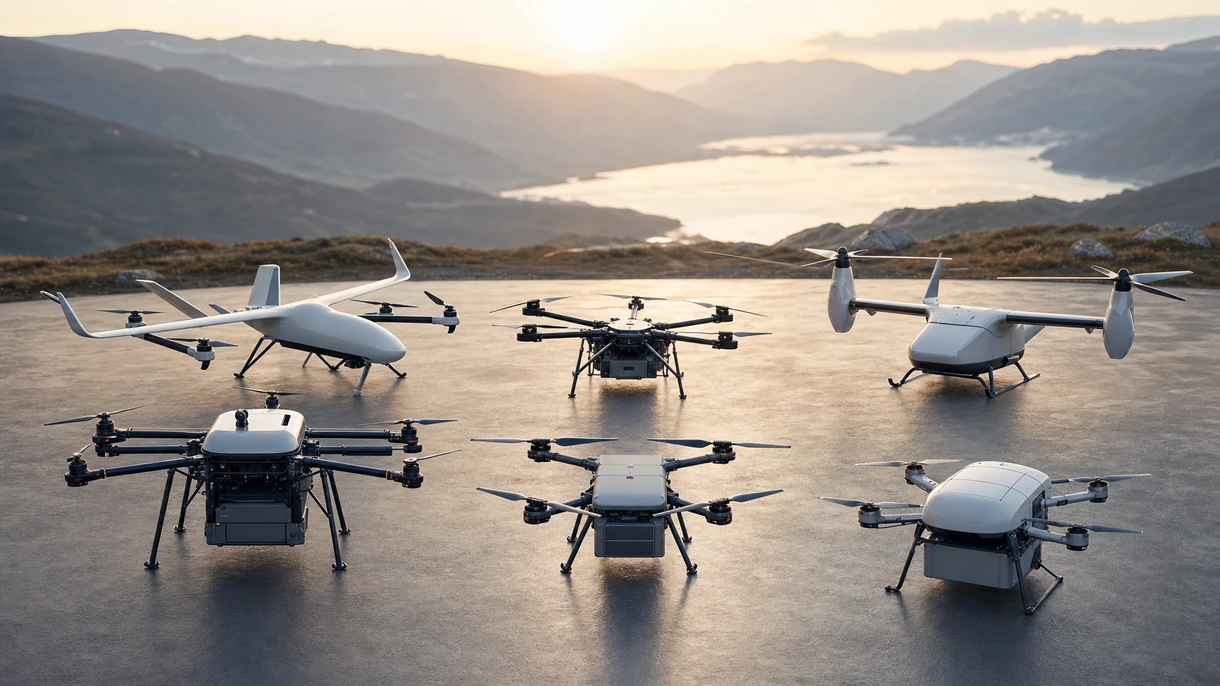
4 Criteria to choose your transport UAV
Maximum Takeoff Weight Capacity
Essential for determining mission capability, ensuring high-density cargo delivery within specified range limits and regulatory weight class boundaries.
Airworthiness Type Certification
Guarantees compliance with EASA SORA or FAA commercial standards, mitigating liability and ensuring safety in shared airspace.
Propulsion Energy Density
Determines flight endurance and turnaround efficiency, balancing battery cycle life or fuel consumption against total operational lifecycle costs.
Redundant Command Links
Critical for Beyond Visual Line of Sight operations, providing robust fail-safe communication through satellite or encrypted cellular networks.
Available technologies and advantages
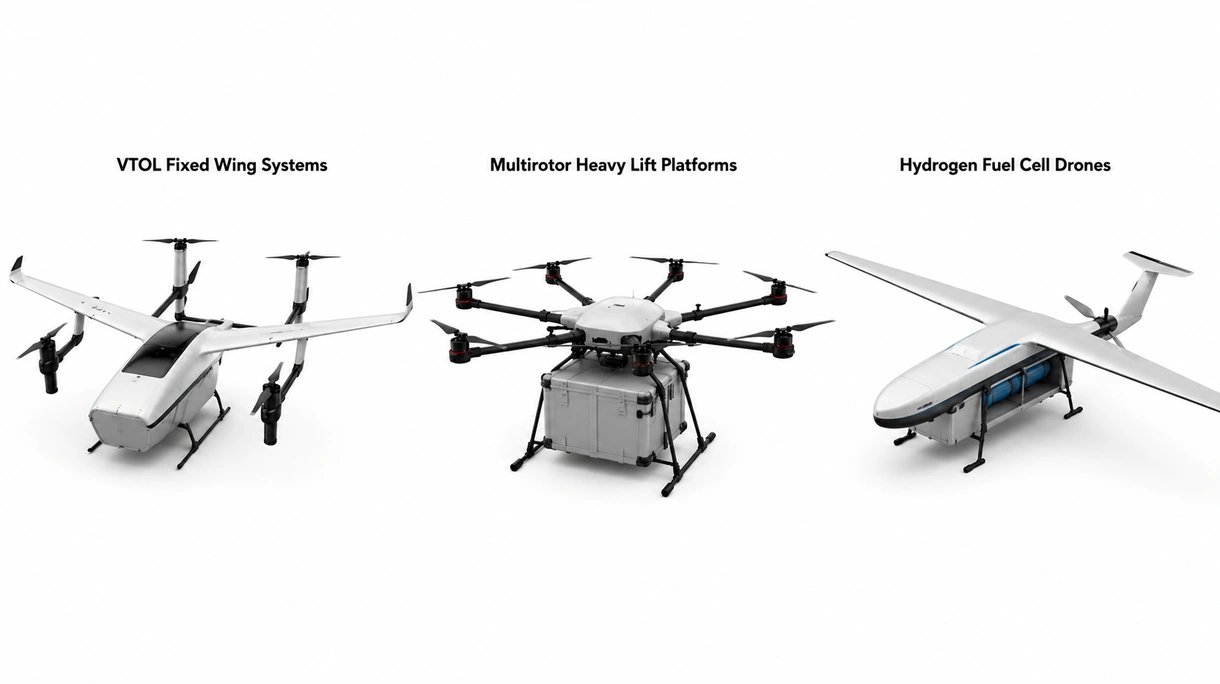
VTOL Fixed Wing Systems
Combining vertical takeoff flexibility with fixed-wing efficiency, these systems maximize range for mid-mile logistics. They offer superior endurance despite mechanical transition complexity.
Operational Performance Factors
Advantage: No runway needed. Limitation: Higher maintenance on tilt-rotors. Trade-off: Range efficiency versus increased mechanical failure points.
Multirotor Heavy Lift Platforms
These platforms provide exceptional hover stability and precise maneuvering for short-range, last-mile delivery tasks. They prioritize simplicity over aerodynamic lift efficiency.
System Capability Tradeoffs
Advantage: Precision landing. Limitation: Low energy efficiency at high speeds. Trade-off: Simplicity versus restricted operational range and flight duration.
Hydrogen Fuel Cell Drones
Utilizing high energy density fuel cells, these drones significantly extend flight durations for long-range cargo missions. They require specialized refueling infrastructure.
Infrastructure Implementation Costs
Advantage: Long endurance. Limitation: Complex logistics for hydrogen storage. Trade-off: Operational time versus high initial infrastructure investment costs.
6 expert tips
Prioritize platforms with existing FAA or EASA type certification to ensure immediate operational legality and reduce insurance premiums significantly.
Mandate a comprehensive lifecycle analysis focusing on battery degradation rates to accurately forecast the total cost of drone ownership.
Select modular airframes that allow for sensor and payload bay swappability to maintain technological relevance across evolving mission profiles.
Evaluate the ground control station interface for multi-uav fleet management capabilities to optimize operator-to-aircraft ratios for cost efficiency.
Ensure hardware compatibility with existing aerospace maintenance tracking software to maintain rigorous airworthiness standards and precise component traceability.
Always verify the technical certification to ensure compliance with local building safety standards and long-term durability.
Innovations and Trends
Advanced onboard sensors provide real-time obstacle evasion, facilitating safe integration into unsegregated commercial airspace for autonomous logistics.
Automated orchestration of multiple transport units increases throughput efficiency and reduces the necessity for pilot-to-aircraft operational ratios.
Utilization of recyclable aerospace-grade composites reduces the environmental footprint while maintaining structural integrity required for heavy payload transport.
Integration of Low Earth Orbit satellite constellations enables global connectivity, removing geographical barriers for remote inter-facility cargo transit.
*Prices are pre-tax. They exclude delivery charges and customs duties and do not include additional charges for installation or activation options. Prices are indicative only and may vary by country, with changes to the cost of raw materials and exchange rates.
About AeroExpo
AeroExpo is a marketplace that offers B2B players a complete experience, from product sourcing to purchase. AeroExpo is an entity of VirtualExpo Group.
Are you a buyer?
Are you a supplier?