
- Home page
- buying guide
- anti-bird system
anti-bird system
anti-bird system: A technical guide

4 Criteria to choose your anti-bird system
FAA EASA Regulatory Compliance
Systems must meet rigorous safety standards to ensure legal operation within international airport maneuvering areas and flight paths.
Multi Species Detection Accuracy
High resolution sensors must distinguish between various avian sizes to prioritize threats based on potential kinetic impact energy.
Non Habituation Deterrence Efficacy
Effective solutions employ randomized stimuli to prevent avian adaptation, ensuring long term reduction in wildlife strikes on runways.
Avionics Frequency Interference Shielding
Equipment must operate on specific bands that do not disrupt critical air traffic control communications or navigation systems.
Available technologies and advantages
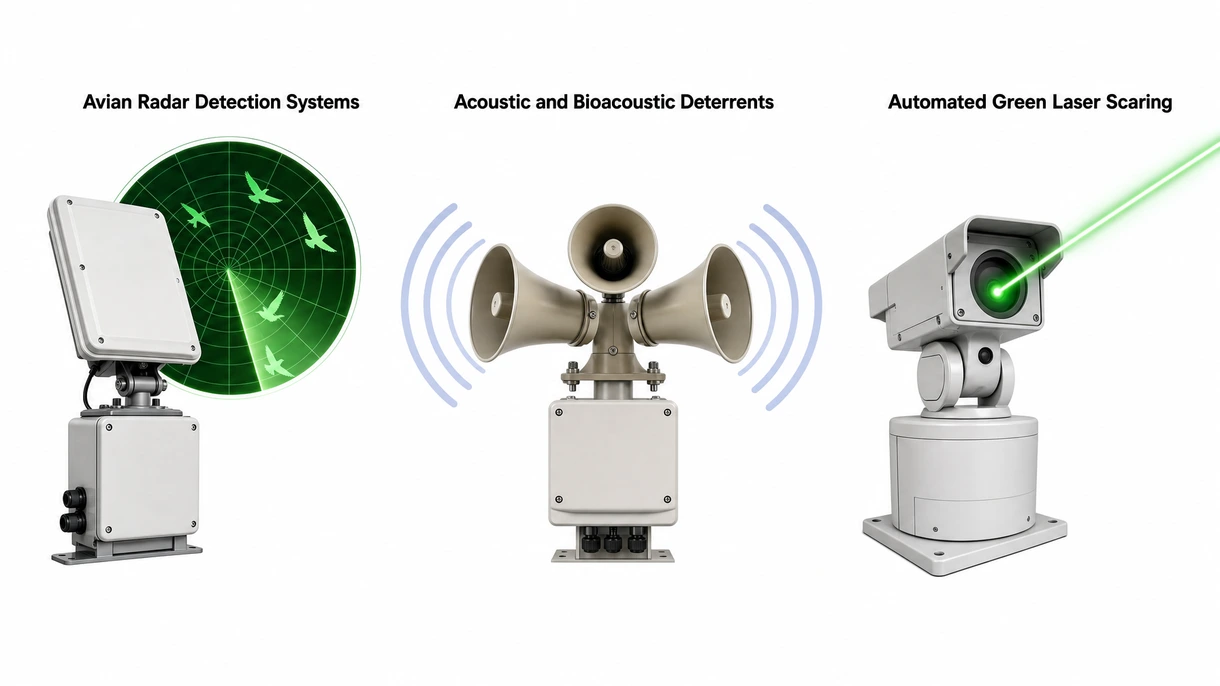
Avian Radar Detection Systems
These systems utilize S-band radar to track bird movements in real-time across the airfield. They provide long-range early warning but require significant capital investment and complex data integration.
Advantages
offer continuous surveillance and wide area coverage. include high infrastructure costs and potential false positives from heavy rain. involve balancing sensitivity against processing power requirements.
Acoustic and Bioacoustic Deterrents
These devices broadcast distress calls to clear zones near taxiways. They offer cost-effective localized protection but effectiveness decreases as birds habituate to repetitive or predictable sound patterns.
Advantages
include easy deployment and low power consumption. are restricted to short range and noise pollution concerns. require frequent sound rotation to maintain effective deterrence levels.
Automated Green Laser Scaring
Automated green lasers sweep runways to create a perceived physical barrier that displaces birds safely. They excel in low-light conditions but performance is limited by heavy fog or solar glare.
Advantages
provide silent operation and high precision targeting. include atmospheric attenuation and strict beam safety protocols. necessitate advanced scheduling to avoid pilot glare during critical flight phases.
6 expert tips
Prioritize integrated radar platforms that provide real-time data feeds directly to air traffic control and ground safety crews.
Evaluate the total cost of ownership by including long term maintenance cycles and sensor calibration requirements for harsh environments.
Ensure all acoustic hardware maintains weatherproofing ratings sufficient for extreme runway exposure and varying international climate conditions.
Select modular architectures that allow for the seamless addition of new sensors as airport infrastructure and traffic volume expands.
Verify that laser systems include safety interlocks to prevent beams from interfering with cockpit visibility or ground personnel.
Conduct thorough environmental impact assessments to confirm that selected deterrents do not negatively affect local non target wildlife populations.
Always verify the technical certification to ensure compliance with local building safety standards and long-term durability.
Innovations and Trends
AI algorithms integrate weather, radar, and historical data to predict bird migration patterns with high operational precision.
Autonomous UAVs mimicking raptor flight patterns provide targeted dispersal of hazardous bird flocks away from active flight paths.
New ultrasonic arrays create invisible sonic barriers that prevent avian entry into high risk engine ingestion zones during takeoff.
Global databases allow airports to share strike data instantly to improve predictive modeling and international safety standards.
*Prices are pre-tax. They exclude delivery charges and customs duties and do not include additional charges for installation or activation options. Prices are indicative only and may vary by country, with changes to the cost of raw materials and exchange rates.
About AeroExpo
AeroExpo is a marketplace that offers B2B players a complete experience, from product sourcing to purchase. AeroExpo is an entity of VirtualExpo Group.
Are you a buyer?
Are you a supplier?