
- Home page
- buying guide
- ground power unit
ground power unit
ground power unit: A technical guide

4 Criteria to choose your ground power unit
Power Quality and Stability
Precise voltage and frequency regulation prevents damage to sensitive avionics and ensures compliance with MIL-STD-704 or ISO 6858 standards.
Total Cost of Ownership
Evaluating fuel consumption, maintenance intervals, and energy efficiency determines the long-term financial viability and return on airport infrastructure investments.
System Reliability and MTBF
High mean time between failures minimizes ground delays and ensures consistent power delivery during critical pre-flight and maintenance operations.
Certification and Standard Compliance
Adherence to EASA or FAA safety regulations ensures seamless integration with various aircraft types and maintains airside operational safety.
Available technologies and advantages
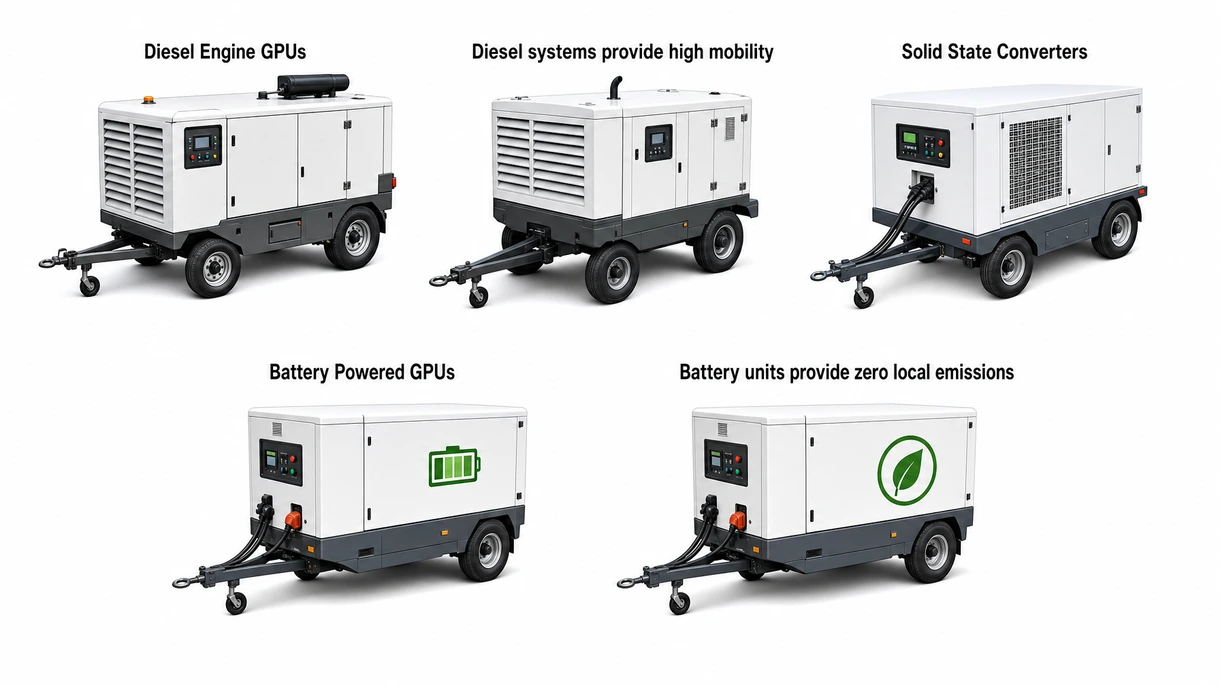
Diesel Engine GPUs
These units utilize internal combustion engines to generate 400Hz or 28VDC power, offering independent mobility in off-grid apron environments.
Operational Trade-offs
Diesel systems provide high mobility for remote aircraft stands but suffer from high carbon emissions and noise levels. The operational trade-off involves essential remote flexibility versus increased maintenance costs compared to electric alternatives.
Solid State Converters
Converting 50/60Hz grid power into high-frequency aircraft power, these stationary units utilize power electronics without moving mechanical parts.
Operational Trade-offs
These converters offer silent operation and extremely low maintenance. The limitation is the fixed infrastructure requirement, making them optimal for terminal gates but lacking mobile flexibility.
Battery Powered GPUs
Leveraging lithium-ion storage, these emission-free units provide clean power through inverters, suitable for indoor hangars and green airports.
Operational Trade-offs
Battery units provide zero local emissions and silent performance. The main limitation is limited operational runtime per charge, requiring significant infrastructure for rapid recharging cycles.
6 expert tips
Prioritize units with telemetry modules to monitor real-time health and prevent unscheduled downtime across expansive airside operations.
Select dual-voltage units to maintain a versatile fleet capable of servicing both narrow-body and large wide-body commercial aircraft.
Validate the harmonic distortion levels to ensure the power supply does not interfere with delicate fly-by-wire navigation systems.
Ensure the enclosure has a high IP rating to protect sensitive electrical components from extreme weather and de-icing fluids.
Invest in modular components to simplify parts replacement and reduce the time required for scheduled maintenance in busy hubs.
Assess the cooling system efficiency to prevent thermal shutdowns during intensive turnaround cycles in high-temperature apron environments.
Always verify the technical certification to ensure compliance with local building safety standards and long-term durability.
Innovations and Trends
Hydrogen fuel cell units provide zero-emission power with faster refueling times than batteries, meeting strict new airport decarbonization mandates.
Predictive maintenance algorithms utilize sensor data to forecast component failures, reducing unscheduled ground support equipment downtime by twenty percent.
Silicon Carbide power electronics increase energy conversion efficiency by five percent while reducing the overall weight and footprint of converters.
Automated remote monitoring allows fleet managers to optimize energy consumption and track unit location across massive international airport hubs.
*Prices are pre-tax. They exclude delivery charges and customs duties and do not include additional charges for installation or activation options. Prices are indicative only and may vary by country, with changes to the cost of raw materials and exchange rates.
About AeroExpo
AeroExpo is a marketplace that offers B2B players a complete experience, from product sourcing to purchase. AeroExpo is an entity of VirtualExpo Group.
Are you a buyer?
Are you a supplier?