
- Home page
- buying guide
- airborne radar
airborne radar
airborne radar: A technical guide

4 Criteria to choose your airborne radar
Multi-mode operational versatility
Integration of weather avoidance and ground mapping ensures comprehensive situational awareness during complex mission profiles and hazardous meteorological flight conditions.
SWaP-C integration efficiency
Minimizing size, weight, and power consumption is essential for airframe integration while maintaining aircraft fuel efficiency and performance.
High probability of detection
Superior signal-to-noise ratios and advanced processing facilitate early identification of small targets or threats at extended operational ranges.
International airworthiness certification
Adherence to global standards ensures system reliability and legal airworthiness within strictly regulated and controlled global aerospace environments.
Available technologies and advantages
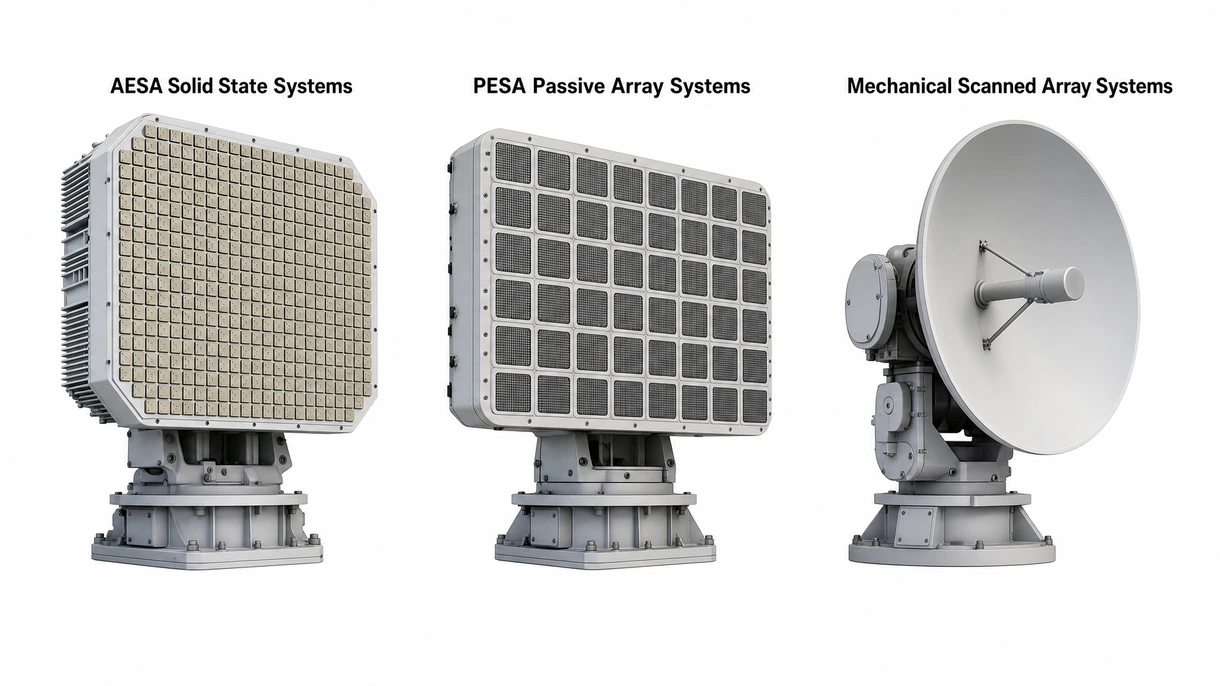
AESA Solid State Systems
AESA radars utilize solid-state transmit-receive modules to steer beams electronically without moving parts, providing nearly instantaneous multi-target tracking capabilities and high frequency agility. These systems offer superior reliability and low intercept probability but require significant thermal management solutions and involve high initial procurement costs.
PESA Passive Array Systems
PESA systems use a single central transmitter feeding multiple phase shifters to direct the radar beam across a wide operational field. These units are more cost-effective than AESA models though they suffer from single-point failure risks and slower beam agility.
Mechanical Scanned Array Systems
These systems physically rotate a parabolic or flat-plate antenna to sweep the surrounding airspace for target acquisition and weather detection. They provide high gain at lower complexity but face mechanical wear issues and slower refresh rates compared to solid-state alternatives.
6 expert tips
Prioritize radar systems featuring integrated Gallium Nitride technology to enhance power efficiency and reduce heat dissipation in confined airframes.
Validate that the chosen radar processing unit supports open architecture standards to facilitate software-defined upgrades without expensive hardware replacement.
Assess the mean time between critical failures to calculate long-term life cycle costs and inventory requirements for spare modules.
Ensure the radar interface seamlessly integrates with existing glass cockpit avionics via high-speed ethernet or standardized serial data protocols.
Conduct comprehensive flight testing under varying atmospheric conditions to verify the effective range against specified radar cross-section targets accurately.
Always verify the technical certification to ensure compliance with local building safety standards and long-term durability.
Innovations and Trends
Implementation of machine learning algorithms allows the radar to adapt waveforms in real-time for enhanced interference rejection capabilities.
GaN technology increases power density by forty percent while reducing weight, directly improving detection range and cooling system efficiency.
Advanced silicon-based integration enables high-resolution imaging capabilities on tactical drones previously restricted to much larger strategic surveillance aircraft.
Emerging quantum-enhanced sensing protocols offer theoretical resistance to electronic jamming and improved detection of low-observable airframes in contested environments.
*Prices are pre-tax. They exclude delivery charges and customs duties and do not include additional charges for installation or activation options. Prices are indicative only and may vary by country, with changes to the cost of raw materials and exchange rates.
About AeroExpo
AeroExpo is a marketplace that offers B2B players a complete experience, from product sourcing to purchase. AeroExpo is an entity of VirtualExpo Group.
Are you a buyer?
Are you a supplier?