
- Home page
- buying guide
- mini UAV
mini UAV
mini UAV: A technical guide
4 Criteria to choose your mini UAV
Regulatory weight class certification
Compliance with EASA and FAA weight categories determines operational risk levels and required pilot certifications for urban environments.
Data link encryption level
Military-grade AES-256 encryption and proprietary frequency hopping ensure mission data integrity against electronic warfare or industrial espionage threats.
SWaP-optimized sensor integration
Balancing size, weight, and power allows integration of thermal or multispectral sensors without compromising flight endurance or stability.
Fleet maintenance reliability metrics
Verified mean time between failures ensures fleet readiness and minimizes total cost of ownership through predictable maintenance cycles.
Available technologies and advantages
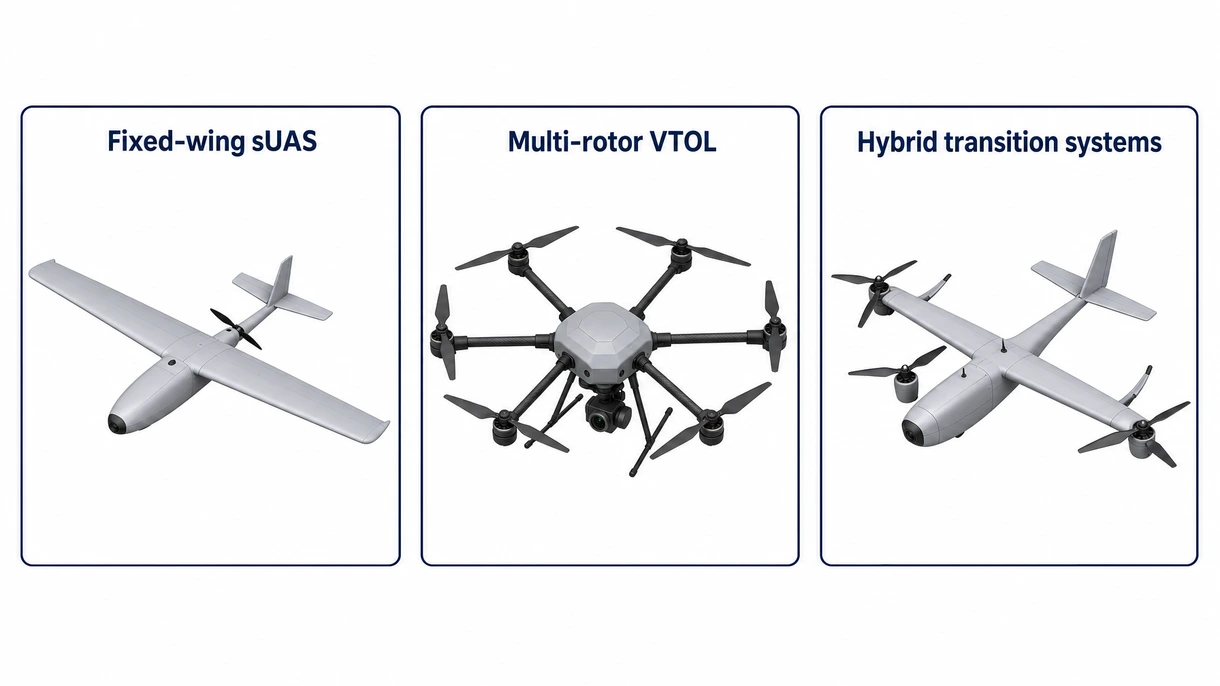
Fixed-wing sUAS
Fixed-wing platforms prioritize aerodynamic efficiency for long-range surveillance, often utilizing composite materials to maximize lift-to-drag ratios during sustained cruise operations.
Operational tradeoffs
Superior endurance and coverage area are balanced against the requirement for dedicated launch space and total lack of hover capability.
Multi-rotor VTOL
Utilizing brushless motors and electronic speed controllers, these systems offer precise positioning and vertical takeoff capability within extremely constrained operational environments.
Operational tradeoffs
Exceptional maneuverability and stationary observation are offset by high battery consumption and significantly limited range compared to aerodynamic wings.
Hybrid transition systems
These aircraft combine vertical lift rotors with horizontal thrust propellers to leverage both hover versatility and efficient forward flight through aerodynamic lift.
Operational tradeoffs
Excellent mission flexibility and range are complicated by increased mechanical complexity and potential failure points during critical flight mode transitions.
6 expert tips
Prioritize platforms with open architecture interfaces to ensure seamless integration with existing ground control stations and geospatial software.
Validate airframe durability through rigorous environmental testing protocols to ensure operational reliability in extreme temperature or high wind conditions.
Assess vendor support capabilities regarding spare parts availability to minimize grounding time and maintain consistent mission readiness levels.
Select units with redundant flight controllers and fail-safe return-to-home protocols to mitigate risks associated with signal loss or hardware failure.
Ensure the propulsion systems utilize high-energy density batteries to maximize flight duration while adhering to strict transport safety regulations.
Confirm the presence of comprehensive telemetry logging features to facilitate thorough post-flight analysis and maintain rigorous maintenance audit trails. Always verify the technical certification to ensure compliance with local building safety standards and long-term durability.
Innovations and Trends
Edge-computing AI integration provides real-time object recognition and autonomous obstacle avoidance without relying on high-latency cloud processing.
Hydrogen fuel cell propulsion extends mission endurance significantly beyond traditional lithium batteries for persistent wide-area surveillance and monitoring.
Remote ID broadcast modules ensure full compliance with evolving FAA and EASA regulations for integrated low-altitude airspace management.
Swarm intelligence algorithms enable multiple mini units to coordinate movements for complex search operations or distributed sensor network applications.
*Prices are pre-tax. They exclude delivery charges and customs duties and do not include additional charges for installation or activation options. Prices are indicative only and may vary by country, with changes to the cost of raw materials and exchange rates.
About AeroExpo
AeroExpo is a marketplace that offers B2B players a complete experience, from product sourcing to purchase. AeroExpo is an entity of VirtualExpo Group.
Are you a buyer?
Are you a supplier?