
- Home page
- buying guide
- sport paraglider
sport paraglider
sport paraglider: A technical guide

4 Criteria to choose your sport paraglider
Certification and Airworthiness Standards
Compliance with EN 926-2 or LTF ensures rigorous testing for structural integrity and predictable aerodynamic flight characteristics.
Aerodynamic Glide Ratio Efficiency
High lift-to-drag ratios permit extended operational ranges and improved energy conservation during long-duration commercial or tactical flight missions.
Structural Material Fatigue Resistance
High-tenacity fabrics and low-stretch aramid lines ensure long-term dimensional stability and safety under high cyclic loading conditions.
Passive Safety Stability Rating
Classification according to pilot skill level minimizes risk of uncontrolled wing collapses during turbulent atmospheric thermal entry maneuvers.
Available technologies and advantages
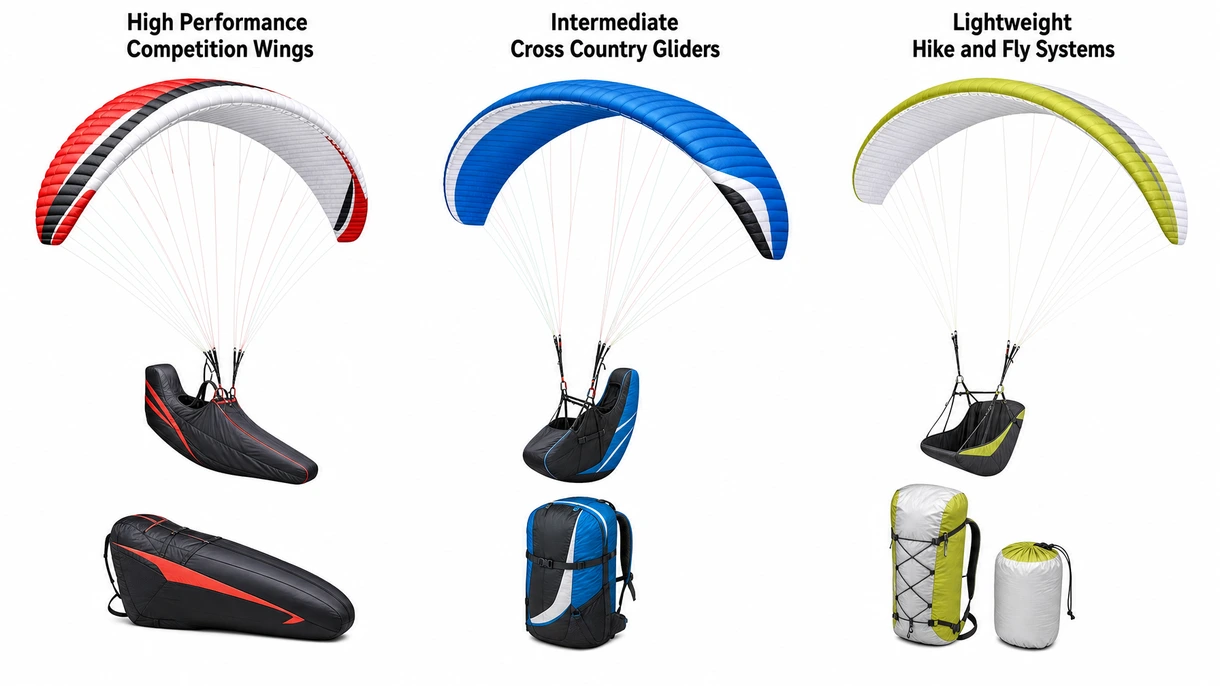
High Performance Competition Wings
These wings utilize high aspect ratios and complex internal rib structures to maximize speed and aerodynamic efficiency profiles during flight. They offer superior glide performance but require expert pilot intervention to manage lower passive safety margins during turbulent air.
Intermediate Cross Country Gliders
Balancing performance with stability, these wings use shark-nose airfoils and optimized internal pressure distribution for consistent aerodynamic lift. They provide reliable glide performance across varied altitudes while maintaining manageable recovery characteristics compared to high-end competition models.
Lightweight Hike and Fly Systems
Engineered with specialized low-denier ripstop fabrics and unsheathed line sets to minimize overall mass for improved mobility. These systems reduce logistical weight burdens significantly but exhibit lower abrasion resistance and shorter operational lifespans than standard wings.
6 expert tips
Verify that all airframes meet current EASA or FAA Part 103 equivalency for legal commercial aerospace operation compliance.
Prioritize vendors offering comprehensive traceability documentation for batch-tested fabric porosity and line strength to ensure long-term reliability.
Evaluate total cost of ownership by calculating maintenance intervals required for laser-guided line re-trimming and fabric permeability testing.
Select wing profiles with integrated internal reinforcement tapes to prevent spanwise deformation during high-speed accelerated flight maneuvers.
Assess the compatibility of the paraglider riser system with emergency reserve parachute deployment mechanisms for integrated safety management.
Demand technical data sheets detailing the ultraviolet degradation rates of specific coating polymers to predict operational lifecycle duration.
Always verify the technical certification to ensure compliance with local building safety standards and long-term durability.
Innovations and Trends
Advanced internal structures increase spanwise rigidity and reduce parasitic drag for enhanced fuel-less aeronautical endurance and speed.
Integration of lightweight sensor arrays provides real-time telemetry data for advanced pilot training and precise atmospheric mapping.
Advanced bio-based synthetic polymers offer improved strength-to-weight ratios while meeting strict aerospace chemical sustainability and recycling regulations.
Automated laser-cutting precision manufacturing ensures zero-deviation wing geometry for perfect symmetry and predictable aerodynamic stall characteristics.
*Prices are pre-tax. They exclude delivery charges and customs duties and do not include additional charges for installation or activation options. Prices are indicative only and may vary by country, with changes to the cost of raw materials and exchange rates.
About AeroExpo
AeroExpo is a marketplace that offers B2B players a complete experience, from product sourcing to purchase. AeroExpo is an entity of VirtualExpo Group.
Are you a buyer?
Are you a supplier?