



- Company
- Products
- Catalogs
- News & Trends
- Exhibitions
Laser engraving machine Mini-inlinefor metalfor plasticscompact


Add to favorites
Compare this product
Characteristics
- Technique
- laser
- Applications
- for plastics, for metal
- Configuration
- compact
- Other characteristics
- high-speed, traceability, horizontal, in-line, vertical
Description
Overview
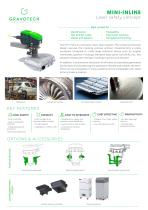
Simplify your laser marking machine integration with the Mini-inline: this laser safety concept protects the laser beam and facilitates particle extraction while avoiding the costs and constraints of a class 1 laser enclosure.
Main benefits
Compatibility & use
Safety systems
The Mini-inline integrates multiple safety measures to prevent unintended laser emission:
Air extraction & maintenance
Double-wall design with local suction at the marking zone for efficient evacuation of smoke and particles. The funnel is easily removable for cleaning. Typical marking cycles before cleaning are high (manufacturer indicates up to ~70,000 cycles depending on application), decreasing downtime and maintenance costs.
Integration & productivity
Designed to be installed directly on the production line or on a robot arm. Because the Mini-inline brings the safety funnel to the part (rather than enclosing the entire part in a large cabinet), cycle times remain low and throughput is preserved for high-speed production.
Applications
Caractéristiques / spécifications techniques
Simplify your laser marking machine integration with the Mini-inline: this laser safety concept protects the laser beam and facilitates particle extraction while avoiding the costs and constraints of a class 1 laser enclosure.
Main benefits
- SAFE: No need for a bulky class 1 laser housing. The Mini-inline isolates the laser beam and its safety sensors ensure the part and the Mini-inline are properly positioned before emission, protecting the operator and the work environment.
- COMPACT: Small footprint designed to be added to existing production lines and to integrate into tight spaces (horizontal or vertical installations). It can be mounted on robotic cells or attached to the laser head for in-line operations.
- COST-EFFECTIVE: Lower acquisition and integration costs compared with a full class 1 enclosure; faster installation and no large pre-study or reengineering of the production line.
Compatibility & use
- Compatible laser sources: Fiber, MOPA, Hybrid (CO2+Fiber), Green (DPSS).
- Typical marking area: compact marking area dedicated to integrable marking workflows.
- Suitable parts: large metal or plastic parts where localised marking and particle extraction at marking point are required.
Safety systems
The Mini-inline integrates multiple safety measures to prevent unintended laser emission:
- Inductive sensors for metallic parts
- Optical sensors for plastic or non-metal parts
- Mini-inline presence sensor
- Safety relay to interlock the laser source until conditions are met
Air extraction & maintenance
Double-wall design with local suction at the marking zone for efficient evacuation of smoke and particles. The funnel is easily removable for cleaning. Typical marking cycles before cleaning are high (manufacturer indicates up to ~70,000 cycles depending on application), decreasing downtime and maintenance costs.
Integration & productivity
Designed to be installed directly on the production line or on a robot arm. Because the Mini-inline brings the safety funnel to the part (rather than enclosing the entire part in a large cabinet), cycle times remain low and throughput is preserved for high-speed production.
Applications
- Industrial part marking and traceability (automotive, aerospace, manufacturing)
- Integrations with robotic cells for in-line marking
- Marking of large or awkward-shaped metal and plastic components where a local class 1 solution is preferred
Caractéristiques / spécifications techniques
- Compatible laser marking heads: Fiber series, MOPA series, Hybrid series, Green series (DPSS)
- Laser sources supported: Fiber, MOPA, DPSS/Green, Hybrid
- Standard marking area: 32 mm x 42 mm (1.26" x 1.65"); other dimensions on request
- Suitable materials: Metals and plastics
- Safety features: inductive sensors (metal), optical sensors (plastic), Mini-inline presence sensor, safety relay interlock
- Air extraction: double-wall funnel with local particle/smoke extraction at marking point
- Easy maintenance: removable funnel for cleaning; very high cycles between maintenance depending on application (manufacturer indicated up to ~70,000 marking cycles)
- Operating temperature: 10 to 40 °C (50 to 104 °F)
- Maximum allowable part temperature: 100 °C
- Dimensions (HxWxD): 293 mm x 192 mm x 168 mm (11.54 x 7.56 x 6.61 in)
VIDEO
Catalogs
Other Gravotech products
Industrial laser marking machines for production lines


*Prices are pre-tax. They exclude delivery charges and customs duties and do not include additional charges for installation or activation options. Prices are indicative only and may vary by country, with changes to the cost of raw materials and exchange rates.
About AeroExpo
AeroExpo is a marketplace that offers B2B players a complete experience, from product sourcing to purchase. AeroExpo is an entity of VirtualExpo Group.
Are you a buyer?
Are you a supplier?