

- Components - Spare Parts
- Avionics
- Aircraft flight data recorder
- Flight Data Systems

- Company
- Products
- Catalogs
- News & Trends
- Exhibitions
Aircraft flight data recorder CVFDRCVRFDR

Add to favorites
Compare this product
Characteristics
- Applications
- for aircraft
- Additional function
- CVR, FDR
Description
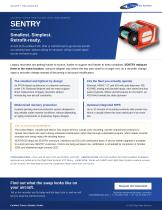
SENTRY CVFDR combines cockpit voice, flight data and data link recording in a single ED-112A unit. For operators carrying two separate recorders today, it removes a box, its mount, its wiring and its weight.
One unit where two used to go
Three recording functions, three TSOs
Optional independent power
Recording duration
Product numbers
FPGA architecture, SWaP optimized
Specifications
Interfaces
Certification
Installation note
Send us the recorder you fly today and the bay it sits in, and we will tell you what the swap involves. customersupport@flightdata.aero
One unit where two used to go
- Combined function in the same envelope and the same 4.5 lb as the single-function units
- On weight-critical platforms, the difference against a two-box installation is the argument
Three recording functions, three TSOs
- TSO-C123c voice, TSO-C124c flight data, TSO-C177a data link, in one line replaceable unit
- Independent fault annunciation per function on separate discrete outputs
Optional independent power
- RIPS maintains recorder and cockpit area microphone for 10 minutes after loss of aircraft power
- Yearly serviceability check, performed with an HHMPI or equivalent
Recording duration
- 2 hours of audio, minimum 2 hours of data link
- Operators requiring 25-hour cockpit voice recording should see SENTRY25, same enclosure, service bulletin upgrade path
Product numbers
- FDS84-3000 and FDS84-3001, SENTRY CVFDR
- FDS84-3100 and FDS84-3101, SENTRY CVFDR with RIPS
- FDS84-4300 Cockpit Control Unit for CVR and FDR installations
- FDS84-5001 Cockpit Area Microphone
FPGA architecture, SWaP optimized
- FPGA-based architecture with SWaP optimization, tailored for modern airframes
- Reduced footprint and low mass support direct replacement of legacy recorders without introducing new aircraft constraints
- Lower steady-state power draw preserves electrical margin for mission and cabin loads
- Contains no software, so recording is licence-free and no proprietary software is needed to retrieve the data
- Optional safety-critical soft-core processor available for third-party software
Specifications
- 3.3 in H x 4.9 in D x 6.0 in W (85 x 124 x 152 mm), base recorder
- 4.5 lb (2.04 kg), titanium enclosure
- 28 V DC, 4.5 W nominal
- Crash survivable to EUROCAE ED-112A
- Patent-pending memory protection system
Interfaces
- Ethernet 10/100 Base-T
- ARINC-717, 64 to 1,024 WPS
- ARINC-429, minimum two inputs
- RS-422/485
- Analog and discrete sensor inputs
- Two rotor speed inputs
- Four audio inputs, high or low fidelity
Certification
- TSO-C123c, TSO-C124c and TSO-C177a
- RIPS configurations add TSO-C155b
- Meets the requirements of EUROCAE ED-112A
- Qualified to DO-160G
- Installation approvals are published in the Flight Data Systems STC library
Installation note
- Flight data function operates on a valid ARINC-717 stream from the aircraft's flight data acquisition unit
- Where no suitable source exists, or outputs do not match, an FDS Modular Acquisition Unit can format data upstream
- Beacon position and the optional RIPS module change the installed envelope. Regional beacon requirements apply, including Canada's mandate for non-lithium Underwater Locator Beacons
Send us the recorder you fly today and the bay it sits in, and we will tell you what the swap involves. customersupport@flightdata.aero
Catalogs
SENTRY Recorders
1 Pages
Data Link Messaging Services
1 Pages
Exhibitions
Meet this supplier at the following exhibition(s):

Other Flight Data Systems products
SENTRY RECORDERS


Related Searches
*Prices are pre-tax. They exclude delivery charges and customs duties and do not include additional charges for installation or activation options. Prices are indicative only and may vary by country, with changes to the cost of raw materials and exchange rates.
About AeroExpo
AeroExpo is a marketplace that offers B2B players a complete experience, from product sourcing to purchase. AeroExpo is an entity of VirtualExpo Group.
Are you a buyer?
Are you a supplier?