


- Company
- Products
- Catalogs
- News & Trends
- Exhibitions
Sheet polyimide Meldin®tuberodaeronautical

Add to favorites
Compare this product
Characteristics
- Shape
- sheet, tube, rod
- Other characteristics
- aeronautical, for the aerospace industry
- Operating temperature
Min.: 23 °C
(73.4 °F)Max.: 316 °C
(600.8 °F)
Description
Overview
Meldin® polyimide materials provide exceptional dimensional stability at elevated temperatures with a balance of wear resistance and friction control. Engineered for durability in extreme environments, these PI-based polymers are used across aerospace, space, semiconductor and industrial sectors where long-term reliability and thermal stability are required.
Available formats & typical parts
Available as stock shapes (sheets, rods, tubes), near‑net molded blanks or precision‑machined finished components. Typical parts include bearings, bushings, piston rings, vane elements, guide rings, thrust washers, wear strips and other custom geometries.
Material families & example grades
Applications / Industry examples
PFAS & regulatory note
Depending on application and specifications, some Meldin® formulations can be produced to meet PFAS‑Free* requirements; PFAS‑Free indicates no intentional addition of PFAS but does not exclude possible trace contamination from the environment.
Features & benefits
Discoverable resources
Product datasheets, comparison infographics and a downloadable Meldin® Polyimides handbook are available on the product page to support material selection and design.
Technical specifications
Meldin® polyimide materials provide exceptional dimensional stability at elevated temperatures with a balance of wear resistance and friction control. Engineered for durability in extreme environments, these PI-based polymers are used across aerospace, space, semiconductor and industrial sectors where long-term reliability and thermal stability are required.
Available formats & typical parts
Available as stock shapes (sheets, rods, tubes), near‑net molded blanks or precision‑machined finished components. Typical parts include bearings, bushings, piston rings, vane elements, guide rings, thrust washers, wear strips and other custom geometries.
Material families & example grades
- Meldin® 2000 PI Based — legacy range with high tensile strength, elongation and compressive strength plus good dimensional stability.
- Meldin® 6000 PI Based — self‑lubricating grades for sustained high‑temperature/high‑load performance and resistance to radiation and aggressive chemicals.
- Meldin® 7000 PI Based — thermosetting polyimides offering extremely high dimensional stability at elevated temperatures (example: <0.04% dimensional change after thermal cycling from 73°F (23°C) to 500°F (260°C) over two days).
- Meldin® 8000/9000 PI Based — porous, lubricant‑impregnated formulations for bearing cages and low‑coefficient‑of‑friction applications.
- Example product references: Meldin® 7001, Meldin® 7021.
Applications / Industry examples
- Aviation: seals, bearings, vane elements and other mission‑critical components.
- Space: components requiring thermal stability, low outgassing and long‑term reliability.
- Semiconductor: parts where thermal stability and material purity are critical.
- Industrial: wear parts, piston rings, guide rings and other high‑temperature mechanical components.
PFAS & regulatory note
Depending on application and specifications, some Meldin® formulations can be produced to meet PFAS‑Free* requirements; PFAS‑Free indicates no intentional addition of PFAS but does not exclude possible trace contamination from the environment.
Features & benefits
- High temperature resistance (family capable of continuous operation up to ~600°F / ≈316°C depending on grade).
- Excellent dimensional stability under thermal cycling.
- Superior wear resistance and friction control for sliding and bearing components.
- Total process control from powder formulation to molded or machined finished parts.
- Longer service life at elevated loads and speeds versus common alternatives, improving lifecycle costs in extreme environments.
- Multiple grades (reinforced, load‑optimized, low‑friction) to match application requirements.
- R&D formulation support and collaborative engineering to tailor materials and components.
- Grades available for direct machining and porous/lubricant‑filled variants for self‑lubrication.
Discoverable resources
Product datasheets, comparison infographics and a downloadable Meldin® Polyimides handbook are available on the product page to support material selection and design.
Technical specifications
- Product family: Meldin® Polyimides (PI‑based series 2000, 6000, 7000, 8000/9000).
- Continuous operating temperature: up to ~600°F (≈316°C) for the family; specific maximum depends on grade.
- Dimensional stability: Meldin® 7000 series cited as <0.04% dimensional variation after cycling 73°F (23°C) to 500°F (260°C) over two days (grade‑dependent).
- Mechanical properties by series: 2000 — high tensile strength & elongation; 7000 — thermoset, extreme dimensional stability; 6000 — self‑lubricating, high temp/load durability; 8000/9000 — porous, lubricant‑impregnated for low friction.
- Typical forms: sheets, rods, tubes, near‑net molded parts and precision‑machined components.
- Chemical/environmental resistance: selected grades offer high resistance to radiation and aggressive chemicals (grade‑dependent).
- PFAS status: can be produced PFAS‑Free* depending on manufacturing path; environmental traces not excluded.
- Manufacturing control: in‑house R&D, formulation development, precision processing and material testing to tune properties for application needs.
Catalogs
Other Omniseal Solutions products
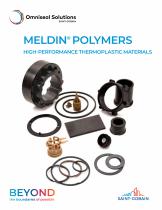
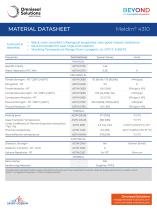
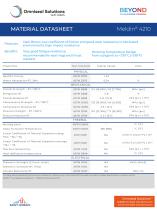
Meldin® Polyimides


*Prices are pre-tax. They exclude delivery charges and customs duties and do not include additional charges for installation or activation options. Prices are indicative only and may vary by country, with changes to the cost of raw materials and exchange rates.
About AeroExpo
AeroExpo is a marketplace that offers B2B players a complete experience, from product sourcing to purchase. AeroExpo is an entity of VirtualExpo Group.
Are you a buyer?
Are you a supplier?